Why Coupon Codes Never Seem to Work and How to Always Find One That Does
You know exactly how this goes. You have spent 20 minutes picking out what you want. The cart looks good. You get to checkout and see the promo code box sitting there like a promise. So you open a new tab, type something like discount code for Amazon or Myntra promo code today, and start trying codes.
First one. Invalid. Second one. Expired. Third one. Does not apply to items in your cart. By the fifth code you are more frustrated than when you started and you either pay full price or abandon the cart completely.
Here is the thing. 85% of online shoppers have abandoned a cart specifically because they could not find a working coupon code. That is not a small number. And the reason it happens so often is not bad luck. It is a structural problem with how most coupon websites work, and once you understand it, you will never waste time on broken codes again.
The Real Reason Coupon Sites Are Full of Codes That Do Not Work
Most coupon websites are not in the business of saving you money. They are in the business of getting you to click.
Here is how it works. A coupon site lists a promo code for a popular store. You visit, click to reveal the code, and get sent to the store's website. The coupon site earns an affiliate commission from that click regardless of whether the code actually works at checkout. There is no financial incentive for them to remove expired codes. Dead codes still drive traffic. Dead codes still earn commissions. So they stay on the page for months, sometimes years, long after they have stopped working.
Research from February 2026 shows that a coupon code that works on Monday can be expired by the following week. Codes lose their validity at a rate of one to two points per day depending on the type. Yet most coupon sites review their listings at best once a month, and many never review them at all.
The result is what you experienced at checkout. A page full of codes that looked legitimate, none of which actually worked.
The Eight Reasons a Coupon Code Fails at Checkout
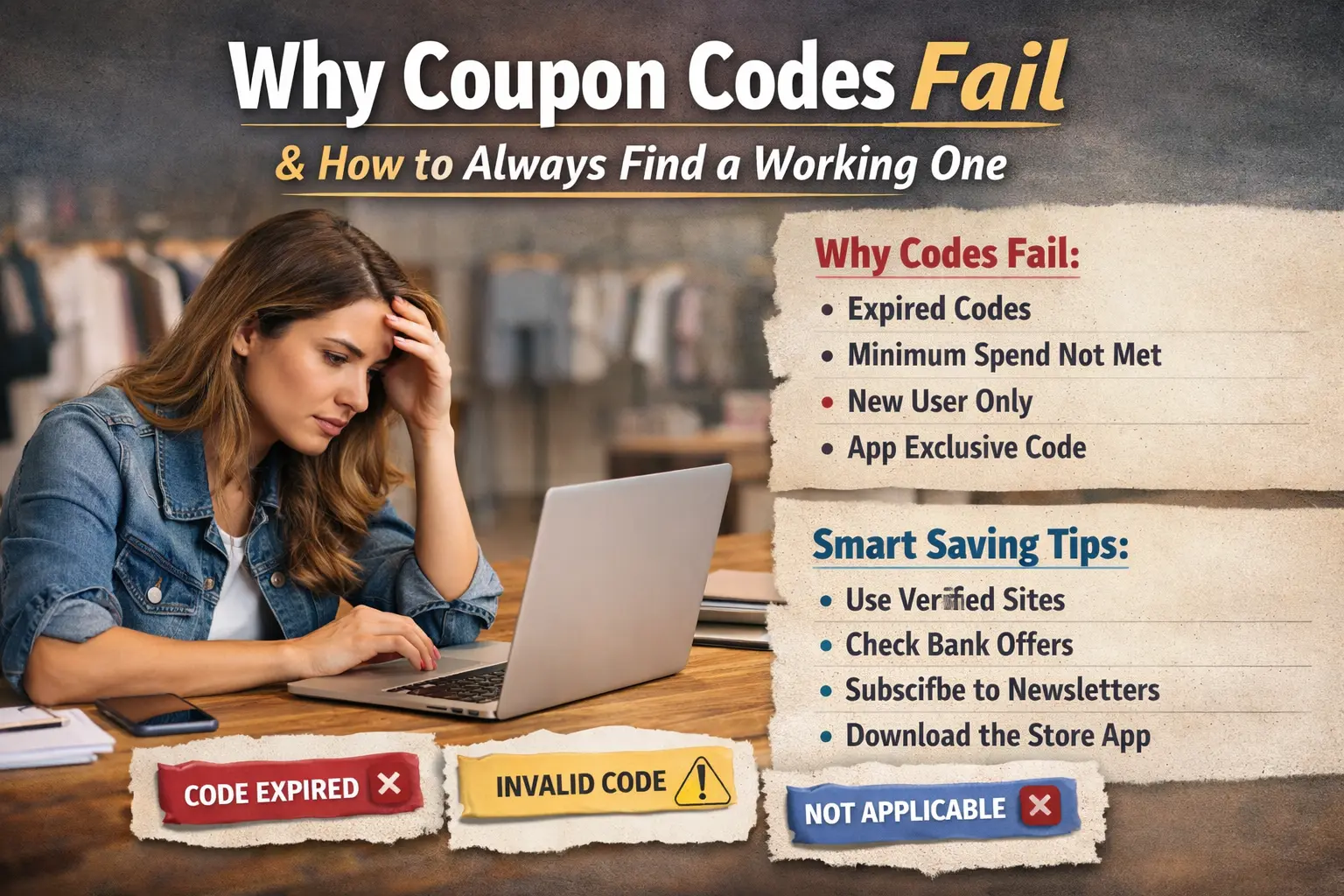
Not all failed codes are expired. Here is the full breakdown of why a code might not apply to your order and what to do about each one:
| Reason Code Fails | How Often It Happens | How to Avoid It |
| Code already expired | Most common reason | Use a platform that shows verified date |
| Minimum spend not met | Very common | Check cart total before applying |
| New user only code used by existing user | Common | Read the terms before using |
| Product category excluded | Frequent | Check exclusions list in code terms |
| One-time code already used by someone else | Increasingly common | Use codes from trusted verified sources only |
| App only code tried on website | Regular issue | Check if code is app exclusive first |
| Region restricted code | Occasional | Use country specific coupon pages |
The most important thing on this list is the last two. App-only codes and region-restricted codes are the two most overlooked reasons for checkout failures. If you are trying a code that says app exclusive and you are on a desktop browser, it will never work regardless of how valid it is. Always check the label on the code before you spend time trying it.
The Numbers That Explain Why Finding a Working Code Feels Impossible
Some real data that puts the problem in perspective. At any given moment, only 40% of online stores have a verified working code available. That means before you even start searching, there is a six in ten chance that no valid code exists for the store you are shopping at.
On top of that, unverified coupon sites see 60 to 80% of their listed codes failing at checkout. Shoppers who use these sites spend an average of five to ten minutes trying codes per shopping session. Across all shoppers worldwide, that adds up to millions of hours wasted every week on codes that were never going to work.
The good news in all of this is that working codes do exist and they are not hard to find once you know where to look and what to look for.
How SnatchSavings Verifies Every Code Before It Goes Live
Every code listed on SnatchSavings goes through an actual checkout test before it appears on the platform. Not a scrape. Not a copy from another site. An actual test to confirm it applies a real discount to a real cart.
| Most Coupon Sites Do This | SnatchSavings Does This |
| Copy codes from other sites without testing | Test every code at actual checkout before listing |
| Keep expired codes live for SEO traffic | Remove expired codes immediately when detected |
| No date shown on when code was last checked | Show verified date on every listing |
| List codes without minimum spend details | Show minimum spend and terms clearly |
| Same codes listed for months without review | Daily review and update cycle for all codes |
The verification date shown on every SnatchSavings listing tells you exactly when the code was last tested. If the date is more than a few days old on a fast-moving store, we flag it for re-verification before it is shown to users.
This is not complicated. It is just a higher standard than most coupon platforms choose to maintain because maintaining it costs time and effort that does not directly improve affiliate click numbers. We do it anyway because a code that does not work is worse than no code at all.
A Simple System That Gets You a Working Code Every Single Time
This takes less than two minutes and works for any store in any country. Follow this order every time you are about to check out.
Step 1: Check Your Cart Total First
Before you look for a code, know your cart value. Most codes have a minimum spend requirement and matching the code to your cart total is the fastest way to avoid the frustration of trying a code that will never work on your current order. If you are close to a minimum threshold, consider adding one small item to unlock a better code tier.
Step 2: Look for Platform-Specific Offers Before Generic Codes
The best discounts are almost never generic public codes. They are bank card offers, app-exclusive deals, and loyalty program discounts that most people miss entirely. If you have an HDFC card in India, a DBS card in Singapore, or a Mastercard in UAE or Hong Kong, check your bank's promotions page before you look for a public promo code. These bank partnerships consistently give higher discounts than anything listed on a coupon site.
Step 3: Check a Verified Platform for Active Codes
When you do need a public promo code, use a platform that shows the verified date next to each listing. If a code was last tested more than two weeks ago on a major retail platform, treat it with caution. SnatchSavings verifies and updates codes daily across all eight markets we cover. India, Singapore, Hong Kong, UAE, Thailand, Malaysia, Philippines, and Germany. The code you find there has been tested recently and is far more likely to work than anything from a generic aggregator site.
Step 4: Subscribe to the Store Newsletter Before Your First Purchase
This is the most consistently overlooked discount available to any shopper. Over 62% of online shoppers sign up for store emails specifically to get coupon codes and most major retailers send a welcome discount of 10% to 15% within minutes of subscribing. For a first-time purchase at a store you want to try, subscribing before you buy is the easiest and most reliable way to get a working discount without any of the code-hunting frustration.
Step 5: Download the App Before Your First Order
Most platforms give an automatic first app order discount that does not require any code at all. Agoda gives 12% off your first hotel booking through the app. FARFETCH gives 10% off your first app order. Myntra gives discounts up to Rs 1,000 for first app purchases. Download the app, make your first purchase there rather than on desktop, and the discount applies at checkout automatically.
When to Shop for Maximum Discounts by Region
Even the best coupon code gives you a fraction of what the right sale timing can deliver. Knowing when each region runs its biggest sales means you can plan purchases around genuine 40% to 80% off events rather than relying on a 10% code to do the heavy lifting.
| Region | Best Sale Events | When to Book for Maximum Saving |
| India | Big Billion Days, Great Indian Festival | September to November, Republic Day January |
| Singapore | 10.10, 11.11, GSS | October to November, June-July GSS period |
| Hong Kong | 11.11, Cyber Monday, FARFETCH sales | November, end of season clearance |
| UAE | Ramadan Sale, White Friday | March to April Ramadan, November White Friday |
| Thailand | 7.7, 8.8 Agoda sales | July and August for hotels and travel deals |
| Malaysia | Lazada and Shopee mega sales | 10.10 and 11.11 for electronics and fashion |
The single most powerful saving strategy that works in every region is to build a wishlist of items you genuinely want and wait for the right sale window to buy them. A Rs 5,000 item at 60% off during Big Billion Days saves you Rs 3,000. The best publicly available code on a random Tuesday saves you Rs 500. The timing matters more than the code.
Why We Keep Trying Codes We Know Probably Will Not Work
There is actually a well-documented reason why people spend so much time trying coupon codes even when they have been burned before. Finding a working discount code triggers a small but real sense of satisfaction that shopping researchers describe as feeling clever. Studies show that 40% of shoppers report emotional satisfaction after successfully using a coupon, separate from the financial benefit.
The flip side is that trying codes that do not work creates genuine frustration that can end a purchase entirely. That same research shows that 15% of shoppers regularly abandon their cart when they cannot find a working discount. Retailers know this and some have started removing the promo code box entirely from checkout to avoid the cart abandonment problem.
The practical takeaway is straightforward. Spending more than two minutes looking for a code is almost never worth it. If you cannot find a verified working code within that window, you are better off using a bank card offer, waiting for the next sale event, or simply completing the purchase. The time cost of extended code hunting consistently exceeds the value of the discount even when you eventually find one.
The Final Line on Coupon Codes
Most coupon codes you find on random sites are not going to work. That is not your fault and it is not bad luck. It is the predictable result of a business model that prioritises affiliate clicks over actual user value.
The fix is simple. Use platforms that verify before listing. Check bank card deals before public codes. Subscribe to newsletters before first purchases. Download apps before first orders. And plan big purchases around the sale events that deliver the real discounts in your region.
At SnatchSavings we test every code before it goes live and remove it the moment it stops working. Every listing shows a verified date so you know exactly how recent the check was. Browse verified deals for your country at snatchsavings.com and spend your time shopping, not hunting.
Also read: Myntra Coupon Code Above 1000 India | Agoda Promo Code Singapore | Qatar Airways Promo Code UAE | FARFETCH Sale Hong Kong Guide
Frequently Asked Questions
Because expired codes still drive affiliate clicks and commissions. When you visit a coupon site and click to reveal a code, the site earns a commission from the resulting visit to the retailer regardless of whether the code works. There is no direct financial incentive to remove expired listings. This is a structural problem with how most coupon platforms are built and the only solution is to use a platform that prioritizes verified accuracy over traffic volume.
Look for three things. A verified badge that confirms the code was tested. A recent verification date showing when it was last checked. And clear terms showing the minimum spend and any exclusions. If a listing does not show all three, the code has a high chance of failing at checkout.
Yes. Use a platform that tests codes before listing rather than copying them from other sites. Check bank partnerships for your specific card before looking for public codes as these are often higher value. Subscribe to store newsletters for first-purchase discounts. And time major purchases around regional sale events where platform-wide discounts of 40% to 80% are available without any code required.
Several reasons. The code might be for new customers only and you are an existing user. It might be region restricted and your account is registered in a different country. It might be tied to a specific payment method like a particular bank card. Or it might be a personalised code sent to a specific email address that will only activate on that account. Always read the full terms of a code before trying it.
The most consistent non-code savings come from three places. First, bank card cashback which applies automatically at payment with no code needed. Second, loyalty programs like Myntra Insider, AgodaVIP, and Qatar Airways Privilege Club which build in discounts and perks over time. Third, sale timing where buying during the right annual event consistently delivers deeper savings than any available promo code.
About the Author

Riya Sharma
Riya specializes in search engine optimization, keyword research, and website performance analysis. With 5+ years of experience, he helps businesses improve their online visibility, increase organic traffic, and achieve sustainable growth through data-driven SEO strategies.